
Agriculture has always been a data-intensive industry. Long before algorithms and cloud platforms, farmers read the land - tracking rainfall, watching soil color, timing harvests by instinct built from years of observation. What has changed is the scale of data now available, and our ability to connect it into something genuinely useful.
Our CEO Jeff Rowe framed the challenge well earlier this year: feeding nearly 10 billion people by 2050 is not a question of farming more land, it is a question of farming existing land far better. That means fusing decades of agronomic expertise with data and AI in ways previous generations could not have imagined. The question I want to address is a more specific one: how do you actually build that infrastructure? What does the architecture of agricultural intelligence look like from the inside?
The answer, at Syngenta, begins with a problem most data leaders will recognize.
Agriculture generates enormous and heterogeneous streams of data - from molecular screening in research labs, to satellite imagery, factory sensors, and farmer mobile apps. Each of these streams carries a fragment of truth. A scientist sees a molecular breakthrough. A grower in Brazil sees a localized pest outbreak. A supply chain manager sees a logistics gap. Separately, these observations are valuable. Connected, they become transformative.
For years, they were not connected. Our R&D teams worked with vast quantities of data trapped across hundreds of legacy tools and fragmented systems - some of it in paper lab notebooks. Accessing the data needed to begin a new research project could take up to nine months. In an industry pressed for faster innovation, that is not inefficiency. That is lost time we cannot afford.
The real problem facing agriculture is not data volume. It is data connectivity.
Building the mesh
So we stopped trying to collect more data and started connecting what we already had.
The result is Gaia, our industry-leading crop protection R&D data hub, and the foundation of Syngenta's federated data mesh model. Gaia ingests and connects data across our entire R&D pipeline - from molecular screening and greenhouse trials to field observations and privacy-protected, aggregated performance insights from farms. It is not a data warehouse in the traditional sense. It is a living mesh: more than 75 data sources, and over 200 billion records.
The adoption numbers reflect what happens when data becomes genuinely accessible. Gaia now has 500 active users - double the figure from a year ago - and data queries have risen fourfold, to over 4 million per month. More importantly, data access times have dropped from months to minutes.
But the more consequential shift is qualitative. Gaia has closed a feedback loop that was broken for years. Real-world observations from farms - pest pressure, yield anomalies, weather events - now flow back into our R&D datasets continuously. A pattern detected across thousands of fields in Brazil this season can inform the molecule a scientist is prioritizing in a Swiss lab next year. Discovery and deployment are no longer separate cycles.
That same federated architecture is now scaling company-wide through Galaxy, our enterprise data platform, extending mesh principles beyond research into commercial, supply chain, and regulatory functions.
Image
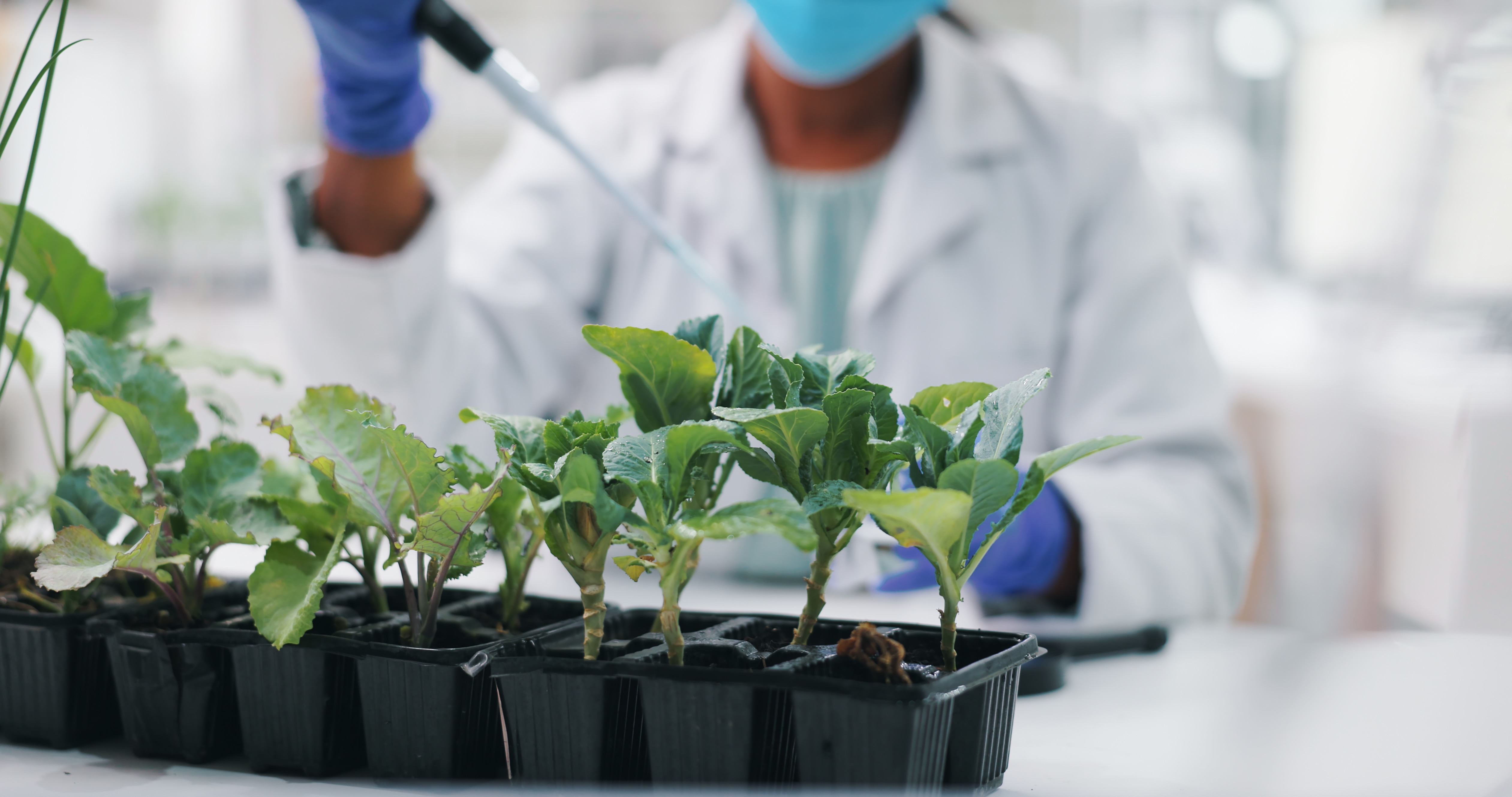
Gaia, our industry-leading crop protection R&D data hub, ingests and connects data across our entire R&D pipeline.
From insight to action
Connected data also delivers value when it reaches those out in the fields: the farmers and the commercial teams who serve them.
For farmers, the interface is Cropwise, our digital agriculture platform, available across six AI-powered applications in over 30 countries and covering more than 70 million hectares. Cropwise combines satellite imagery, localized weather data, soil models, and decades of agronomic research to deliver hyper-local crop advice - in the farmer's own language, on their phone, in near real time. Farmers retain ownership of their data. That principle is built into the design from the start, and it is the foundation of the trust that drives adoption.
For our commercial teams, the interface is Lynx - Syngenta's commercial AI platform, built on Salesforce Agentforce. Lynx brings AI-driven insight directly into the CRM workflows sales, marketing, and pricing teams already use. It surfaces instant recommendations, automates manual tasks, and gives commercial teams the confidence to focus on what matters most: building customer relationships and driving value for growers. Where Cropwise serves the farmer, Lynx serves the people closest to the farmer. Together, they represent the last mile of the intelligence we build.
The bigger picture
None of this happened through technology alone. The cultural shift mattered as much as the architecture - domain teams taking ownership of their data as a product, not treating it as someone else's infrastructure problem. Governance, upskilling, and trust-building were as important as the platform decisions.
The broader ambition is equity as much as efficiency. Over 500 million smallholder farmers underpin global food security, and the digital divide between large operations and smaller ones remains wide. When data is unified and made accessible, AI can become a genuine equalizer - extending the reach of science to every farm, regardless of size or geography.
Agriculture has entered a new era. The farmers and companies that thrive will be those who treat data not as something to store, but as something to connect. That is the shift - and the opportunity - that agricultural intelligence represents.
More from Syngenta Group