
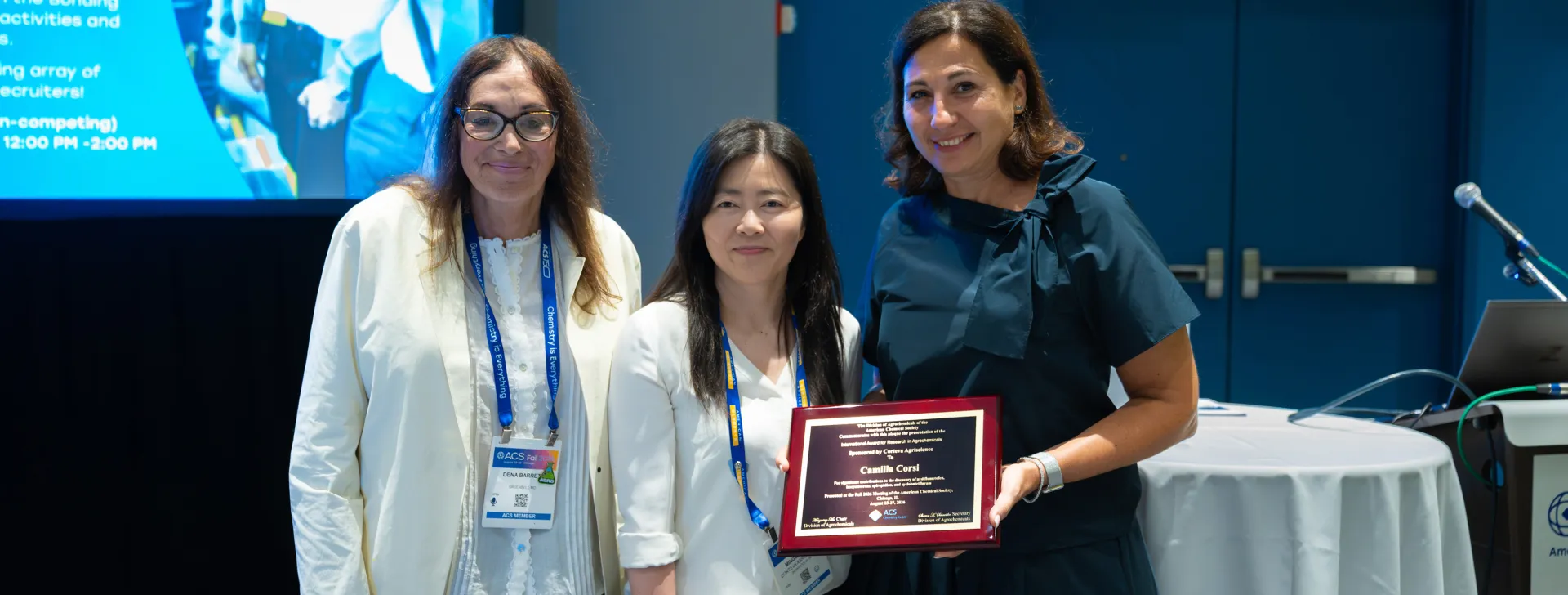
Camilla Corsi, Head of Crop Protection Research & Development at Syngenta, has been recognized by the American Chemical Society with its prestigious International Award for Research in Agrochemicals.
The annual award, first bestowed in 1969, is in recognition of Corsi’s influential leadership and contribution to a new generation of crop protection products that deliver powerful disease, pest and nematode control across a wide range of crops and geographies. Syngenta’s portfolio of industry-leading crop protection products demonstrates how early-stage research and investment, as practiced by Corsi and her global team of more than 3,000 scientists and technologists, can lead to such breakthroughs.
The award was announced at the twice-yearly meeting of the American Chemical Society, held at Chicago’s McCormick Place Convention Center. The event brought together more than 10,000 chemists, researchers, educators, students and industry professionals. ACS, founded in 1876, is the world’s largest scientific society, with a membership of over 200,000 chemistry practitioners.
Image
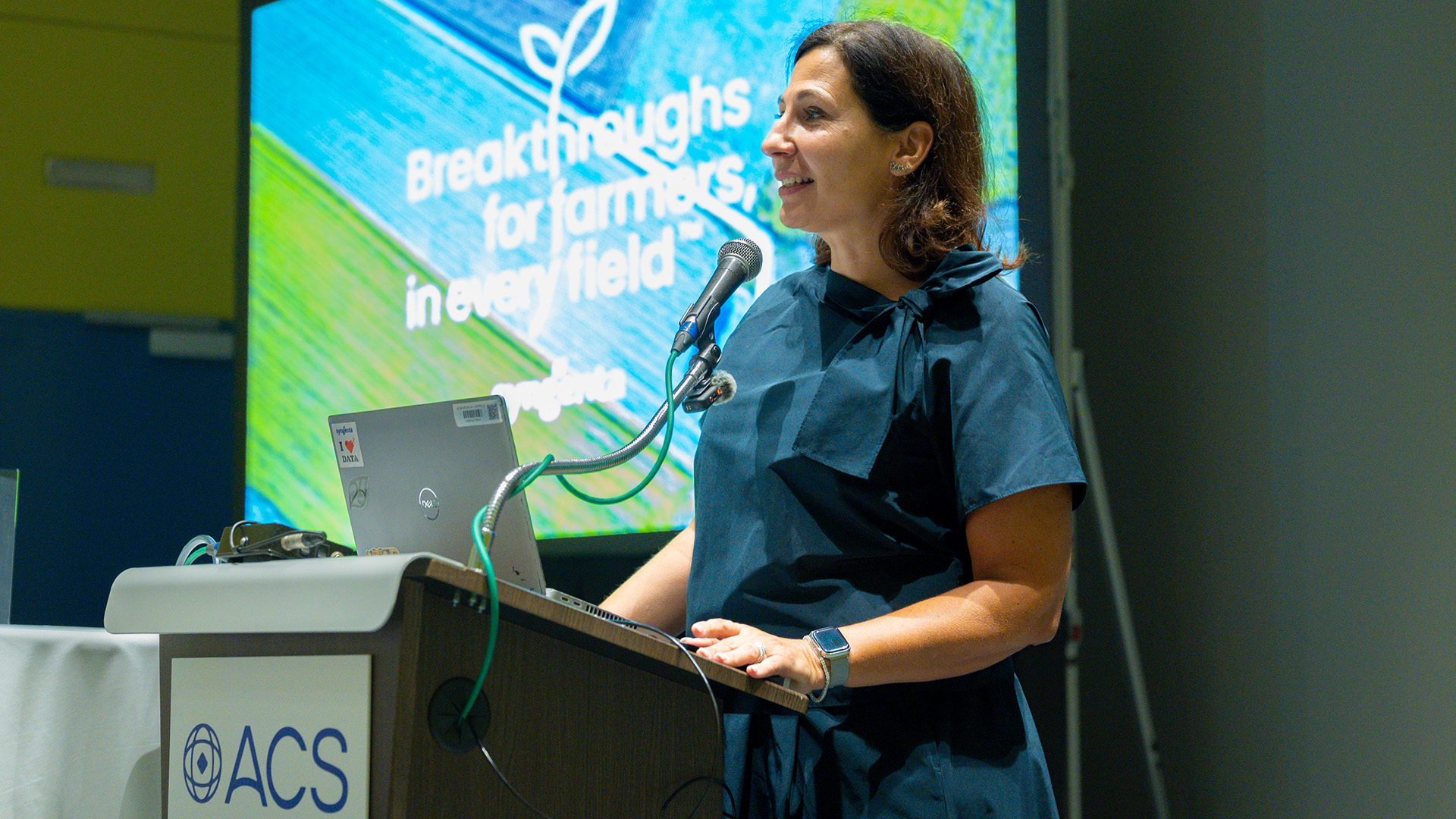
The award recognises Camilla Corsi’s influential leadership and contribution to a new generation of crop protection products.
Peter Maienfisch, executive director of CreInSol MCB and a former research portfolio manager with Syngenta Crop Protection, introduced Corsi. He noted that, while one other woman has been recognized by ACS – in partnership with colleagues – Corsi becomes the first “solo” female award winner.
Corsi, who earned a PhD in organic chemistry from University College London, joined Syngenta in 2004. She was appointed head of the company’s Crop Protection Research & Development organization in January 2025.
During the ACS symposium held in her honor, Corsi gave a presentation titled, “A Quarter Century of Crop Protection Innovation.” She thanked ACS for the honor and noted that agrochemical research requires a long-term commitment, often taking more than 10 years from early explorations to commercial viability for a given product. Syngenta, founded in 2000, celebrated its 25th anniversary last year.
Image

Peter Maienfisch, Executive Director, CrelnSol MCB, introduces Camilla to the symposium ahead of her acceptance speech.
“I’m humbled to see so many people here to hear about the last 25 years at Syngenta,” she said. “We all know that innovation takes many years before coming to market, with many learnings along the way.”
Syngenta’s industry-leading crop protection products include ADEPIDYN® technology, a next-generation fungicide; TINIVION® technology, which offers long-lasting control against sucking pests; TYMIRIUM® technology, for controlling plant-parasitic nematodes and soil-borne fungal diseases, while safeguarding soil health and biodiversity; and PLINAZOLIN® technology, which offers powerful control across a broad range of insect pests. Most recently, we added VIRESTINA™ technology, which tackles herbicide resistant grassweeds, maximizing yield for soybean and other key crops.
Corsi illustrated how technologies like ADEPIDYN® technology offer diverse benefits, including low chemical usage and control of mycotoxins, to both growers and stakeholders. Plants treated with ADEPIDYN® technology produce greener leaves, which are capable of capturing more light and conserving water due to lower transpiration. Together, these advantages contribute to higher yield, improved quality and greater sustainability.
Simultaneous problem-solving
Corsi noted that the integration of chemical and biological solutions brings together the best of both worlds, combining synthetic precision with biological mechanisms to deliver superior performance while minimizing environmental impact.
At the same time, digital technologies — including machine learning, artificial intelligence, large language models and predictive analytics — are driving a shift from traditional, sequential “waterfall” research methodologies to multi-parameter optimization, or MPO. MPO enables simultaneous problem-solving, making it possible to design, synthesize, test and analyze in response to customer needs, faster and more effectively.
Corsi explained how Syngenta is applying MPO to speed up processes and deliver better products that are optimized to meet the needs of customers, regulators and other stakeholders. She compared MPO to a multi-dimensional Rubik’s Cube. “We’re able to look at all the different properties at the same time,” she said.
Agricultural R&D is in the midst of fast-moving transformation: Machine learning is accelerating the discovery of novel active ingredients, while generative design makes it possible to deliver better products, faster. In the crop fields, drone-based detection and AI-generated agronomic advice make precision farming possible at scale. And AI-driven demand forecasting is optimizing logistics and supply chains.
Advances in research and development must be approved region by region. Crop protection is one of the world’s most highly regulated industries. To gain and maintain registration, an active ingredient must be safe for workers, the environment, crops and consumers. Differences in these regulatory systems are factored as early as possible into the research phase, she said.
Image
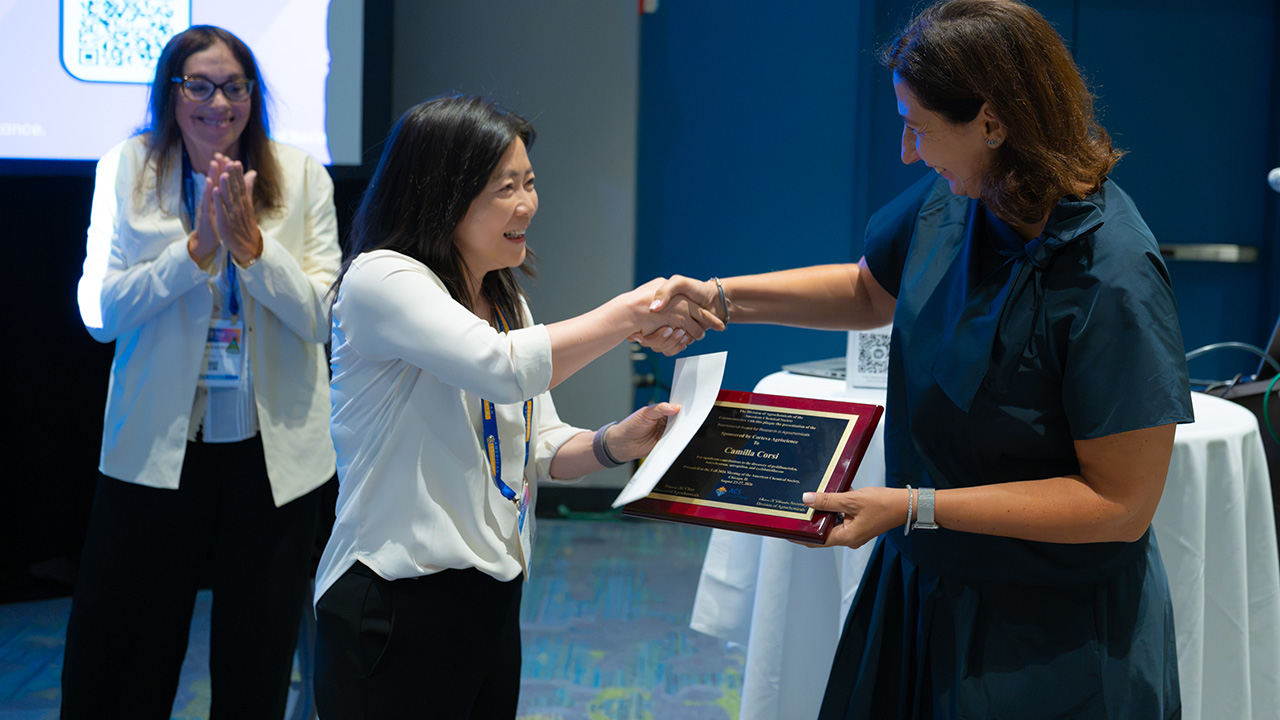
Camilla says receiving this international award is a great recognition of the outstanding science being conducted at Syngenta.
Tackling agriculture's grand challenges
Corsi was asked what inspired her to choose agrochemistry as a career path. She pointed to the influence of mentors and her father and acknowledged that “agro” wasn’t the most popular choice among her academic cohort. “All my colleagues went to pharma,” she said.
However, Corsi believes that agrochemisty is now on par with pharmaceuticals when it comes to scientific breakthroughs and product development. “We have some leading innovations that can go head-to-head with pharma,” she said.
Agriculture must tackle a series of “grand challenges” by 2050, according to Corsi. They include preserving soils, producing more food, stemming biodiversity loss, reducing emissions and eliminating farmer poverty.
The answer, at least in part, is that a convergence of sciences — biology, chemistry, digital/analytical and automation — is creating a promising new era of innovation in agricultural technology.
This kind of scientific and industry transformation requires a change in mindset. “We need to continue to challenge ourselves,” Corsi said. “I’m optimistic we’re moving in the right direction.”
Corsi helps drive transformation within Syngenta as a co-sponsor of its Women Leading in Science network. She is also an advocate for women and girls in STEM and in supporting the next generation of female science leaders.